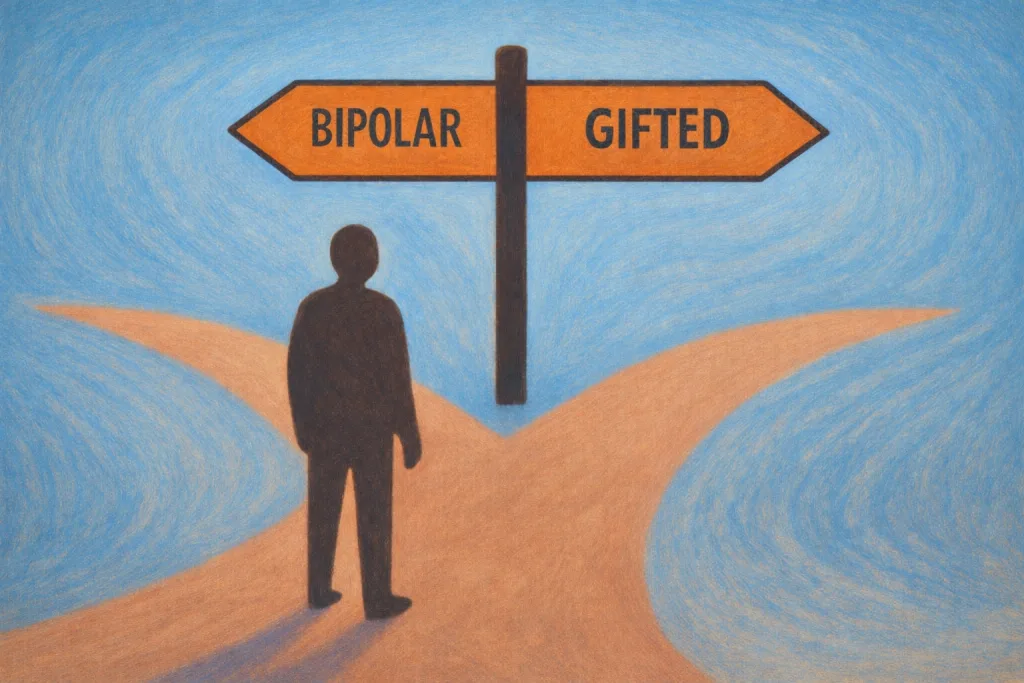


My diagnostic journey began at 21. Well, technically, I saw a psychologist when I was 6. After only a few sessions studying me, she concluded that nothing could be done with me and the follow-up stopped. Stellar professional work, you might say (sarcasm). I still remember refusing to follow her instructions because they seemed absurd to me. At 16 and a half, I gradually developed grandiose ideas, I chained projects together, I drew, I wrote, my grades dropped. That turned out to be my first manic episode, sprinkled with a touch of psychosis. It was also the beginning of a long epic.
I call it an epic because the manic episode flew under everyone’s radar. People could clearly see that I was extremely efficient, that I had plenty of ideas, that I had completely lost it thinking I could get into MIT (Massachusetts Institute of Technology, one of the top engineering schools in the world) with my 11/20 average. My mother wanted me to see a psychiatrist but my father discouraged her.
And eventually, I crashed.
The episodes that followed
First depression. Except that to me, depression was an invention of weak people who simply wanted to daydream instead of working. So I went into full denial, cried silently in the shower or in my bed, and forced myself to keep attending classes. Since I had become a master of masking, hiding a depression didn’t require much effort. My mother told me years later that she had nevertheless clearly sensed that something was wrong. That must be some kind of slightly mystical mom thing, because she can identify any altered state of consciousness I’m in. The depression ended a few months later just before I arrived in mainland France.
In the years that followed, I went through one depressive phase after another, along with episodes where I felt really good (but not as good as the first time, so nothing abnormal). As for the depressions, I eventually learned to recognize them after researching the subject. I kept masking them from the rest of the world, and it was even easier with my family living 8,000 km away from me.
A very severe depression
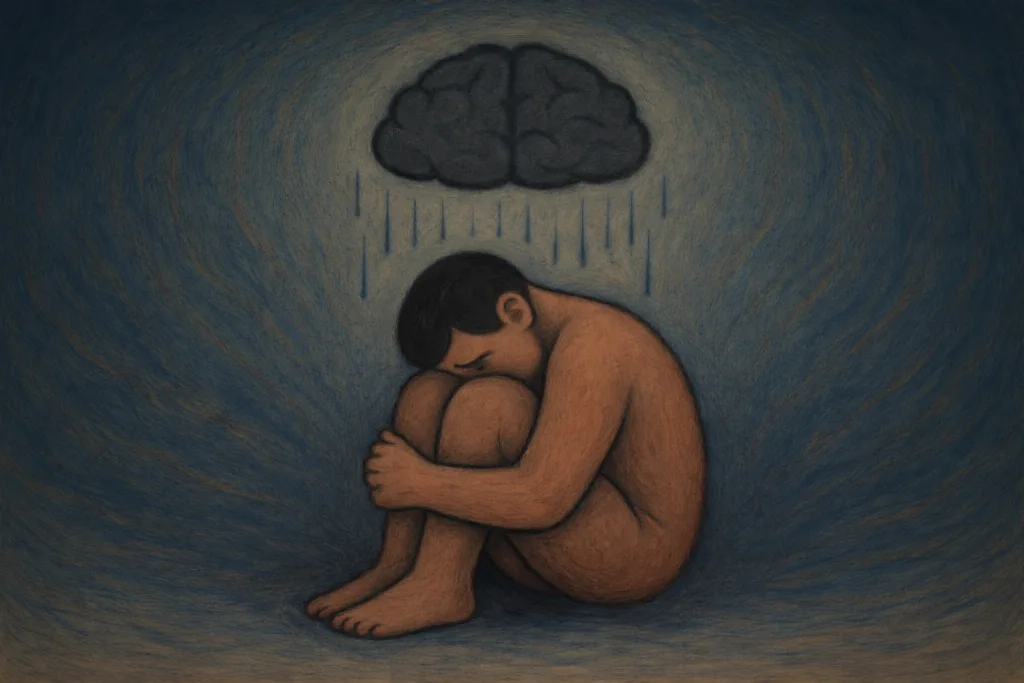
At 20, however, a major upheaval: a series of changes in my life, both relational and academic, punctuated by failures, triggered a very severe depression. I could no longer hide it. I no longer wanted to hide it. My mother stepped in and supported me as best she could, witnessing a true descent into hell. I was no longer capable of anything: I didn’t want to get out of bed, I cried in front of her, my grades at the IUT collapsed (when I even showed up, because I was skipping almost all my classes), and to maximize my chances of letting the illness destroy me, it all happened just before I was supposed to leave for my end-of-studies internship in Cambodia.
When depression triggers self-destruction
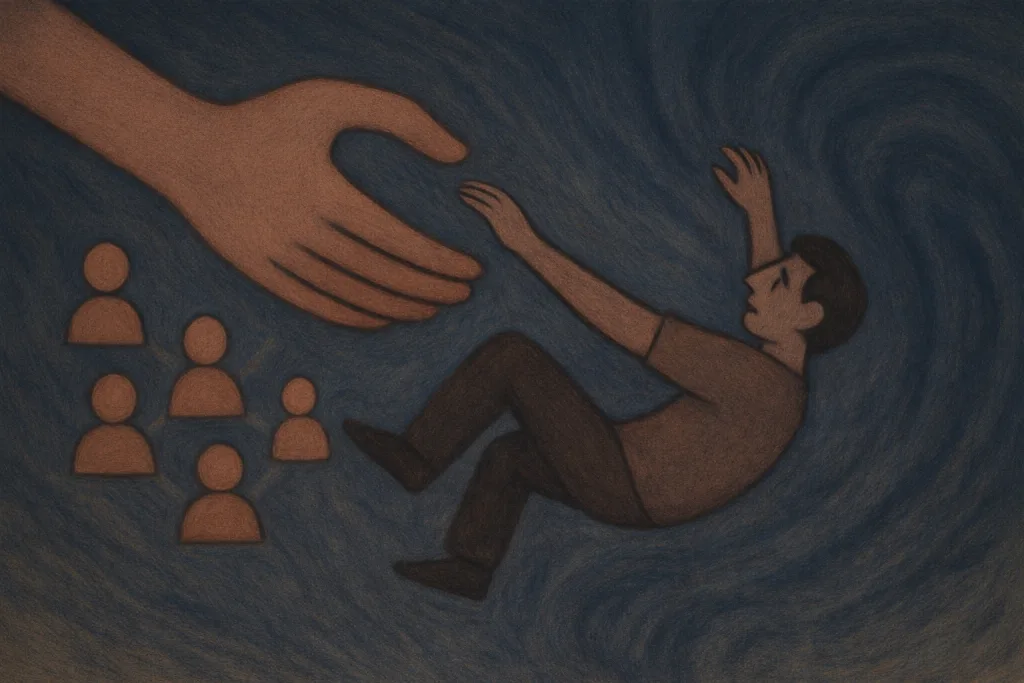
Everyone is on high alert and tries to help me as best they can, but nothing works: I am on the edge of the abyss. My best friend at the time does everything he can to motivate me to work on my math to avoid having to repeat the year, while I already struggle just to get out of bed, walk 50 cm to reach the saucepan, and cook pasta. I lose 8 kg, I do nothing but sleep, and I have lost all hope of getting better. As for mathematics, I’ve resigned myself: I’m doomed. I’m going to repeat the year, I’m useless, I’m worthless. Just weeks earlier I had been top of my class in programming, probably the student who deserved the diploma the most, and everything collapses.
My mother forces me to see the university psychologist, who brings me nothing more than a confirmation of depression. The problem is that yes, I am depressed, but that doesn’t explain why it is so recurrent.
When my professors saved my year
In Cambodia, the depression continues for some time to the point that I “threaten” to return home and drop out. It’s important to understand that this is not a defeat or a whim but a real total loss of motivation in a world whose colors I no longer see, in a world where I do not understand how people manage to be happy. It is beyond my comprehension.
Without going into details, my mother gets the IUT involved and some adjustments are made so that I narrowly pass the year. Some professors who refused to see me fail saved my year. It took me years to accept it because it still officially felt like a failure to me, no matter what the transcript said.
Possible first answers
The following summer, in the car on the way back from vacation with my father, I browse articles on the subject and unexpectedly come across… bipolar disorder. I didn’t even know the term, let alone the prejudices that came with it. So I read the description of mania, and it resonates within me like the explanation I needed to finally breathe. Maybe I was concerned, and if that were the case, I no longer had to feel guilty or constantly devalue myself because of what I was experiencing. I tell my father about it, he dismisses the hypothesis, and I set the subject aside.
The path toward diagnosis
A new period of superhuman productivity
I begin my first year of engineering school and trigger a hypomanic episode bordering on mania. I sleep only 2 to 3 hours a night, party every evening, knock out an entire cohort of 200 computer science students, all while treating school like a game. Observing my programming performance contributes greatly to a growing feeling of being some kind of living god, of invincibility and rather extreme self-valorization. I eventually crash four weeks later.
First consultation with a psychiatrist
There is hardly any doubt left, but refusing self-diagnosis, I go see a psychiatrist. He has me fill out a questionnaire with symptom descriptions — ones I already know after doing my research. I check every single box without exception. Given the depressive state I’m in, it probably isn’t difficult for him to make the diagnosis.
Without saying a word (which I still find somewhat questionable — I prefer transparency), he scribbles a prescription and I leave with a mood stabilizer. I am officially bipolar. After five years wandering between very severe depressions and more subtle euphoric episodes, I finally find a form of relief.
A difficult treatment
The rest of the story involves treatment adjustments, medication changes, rapid cycling, manic episodes (always with my good friend psychosis) and severe depressive episodes, and hospitalizations (between 7 and 8). I was initially diagnosed with bipolar type II, despite having told the story of my first manic episode, which clearly suggested something far more severe than simple hypomania. My first hospitalization, one year later, changes my diagnosis to type I, as it involves a mixed episode accompanied by strange ideas and hallucinations (voices, apparitions in the corner of my eyes).
A diagnosis that explains (almost) everything
The diagnosis also explains all my addictive tendencies that have followed me since I was 19, notably due to repeated and regular depressions, but also to manias, which my substance use calms by soothing or numbing me (when it doesn’t do the opposite — namely, stimulate me even more than I already am). In just a few years before this diagnosis, my life was repeatedly upheaved by this disorder, shattering my ability to function fully and succeed in my studies to the point that I ultimately abandoned them completely.
Bipolar disorder will also mask for several years my most everyday disability. My autism goes completely unnoticed because the episodes alter the nature of my autistic symptoms, which is why many people will be surprised to learn that I am autistic. But I will come back to this in the article dedicated to the autism diagnostic journey.
I have solved part of my internal puzzle: five years of my story, at the age of 21, find a justification. That is enough for me… until someone comes to cast doubt on this diagnosis. A friend suggests that I am not bipolar but simply prone to the hypersensitivity that giftedness can induce. And off we go again for another ride through the medical world — or rather the psychological one in this case. Spoiler alert: I won’t get much out of what follows, which I will tell you about in the next episode.