
• Français
  • English
  • Bipolar disorder

    I’m autistic, I have bipolar disorder: why the words matter

    No Comments

    Should you say “I’m autistic” or “I have autism spectrum disorder”? And should you say “I’m bipolar” or “I have bipolar disorder”? These questions regularly spark debate. Yet over the years, the way I talk about both has changed completely. It evolved alongside the way I came to see them. For years, I said I was bipolar. Today, I say I have bipolar disorder. A subtle but important difference. Likewise, I rarely say I have autism spectrum disorder (ASD). I’m autistic. Another subtle distinction. Behind these different ways of speaking lies a fundamentally different way of viewing two realities: a psychiatric illness and a neurodevelopmental condition. For me, this shift happened gradually and almost naturally.

    When Everything Becomes Funny: Humor During a Manic Episode

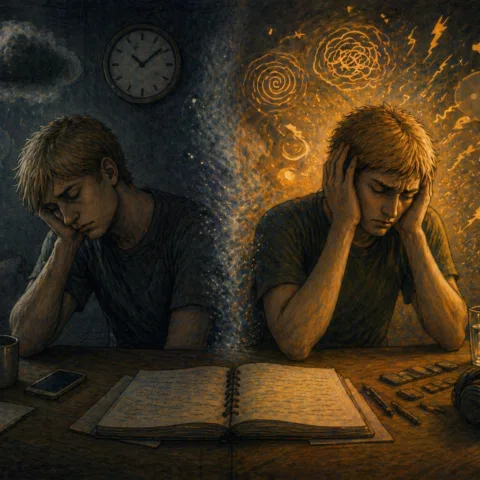
    I recently wrote about humor in autism. What becomes particularly fascinating is seeing how a manic episode can transform the sense of humor of people with bipolar disorder, including those who are autistic. Mania can profoundly change behavior, including the way someone laughs and what they find funny. For some people, it brings intense euphoria, disinhibition, and racing thoughts, completely altering their perception of what is amusing. The relationship between mania and humor can therefore become especially striking.

    Autistic burnout or depression: how can you tell the difference?

    No Comments

    Many autistic people have experienced — or will experience — at least one autistic burnout in their lifetime. For many, it becomes a diagnostic turning point. Professionals, often poorly informed on the subject, frequently misdiagnose it as depression. To their credit, the phenomenon is widely known within the community but still remains poorly explored in the scientific literature. Yet autistic burnout is a very different syndrome from depression.

    Double-edged creativity: when autism and bipolar disorder intertwine

    No Comments

    This article follows the one describing graphorrhea. In August 2019, the manager of Nintendo-Master.com (which I had completely redesigned and then left five years earlier) calls me for help: the site is collapsing in terms of traffic, plagued by a whole range of bugs, and needs another overhaul. I have just been hospitalized for the first time and have developed a full manic episode. Out of love for the site, I jump at the opportunity: it’s time to put my skills to use again. En garde!

    World Bipolar Day: raising awareness in one day for something that lasts a lifetime

    Today is World Bipolar Day. And honestly, I don’t really relate to it. I’ve never changed my profile picture to add a small ribbon, I’ve never used it as an opportunity to raise awareness, and I’ve never taken part in events around this day. Although I understand that it may be meaningful for some, I’ve always struggled to see the value of these awareness days.

    Journey #2: Identifying Giftedness

    No Comments

    “What do you think about the outcome of these tests?” the neuropsychologist in charge of my IQ assessment asked me. I will always remember that moment. At that instant, I hoped that identifying giftedness would be enough to rule out the bipolar cause. So I answered, naturally, that I suspected a confirmation of giftedness. I was right. I was formally identified as very highly gifted by a neuropsychologist… and I believed it would resolve all my difficulties.

    Manic graphorrhea: writing as I breathe

    No Comments

    Manic graphorrhea is a compulsion to write that can occur during a manic or hypomanic episode to someone affected by bipolar disorder. Thoughts flow so quickly that it can become difficult, or even impossible, to stop writing. For some people with bipolar disorder, this acceleration of thought turns writing into an almost vital need. I know that feeling well: during my manic episodes, I sometimes felt as though I was writing as naturally as I was breathing.

    Journey #1: The Diagnosis of Bipolar Disorder

    No Comments

    My diagnostic journey began at 21. Well, technically, I saw a psychologist when I was 6. After only a few sessions studying me, she concluded that nothing could be done with me and the follow-up stopped. Stellar professional work, you might say (sarcasm). I still remember refusing to follow her instructions because they seemed absurd to me. At 16 and a half, I gradually developed grandiose ideas, I chained projects together, I drew, I wrote, my grades dropped. That turned out to be my first manic episode, sprinkled with a touch of psychosis. It was also the beginning of a long epic.