




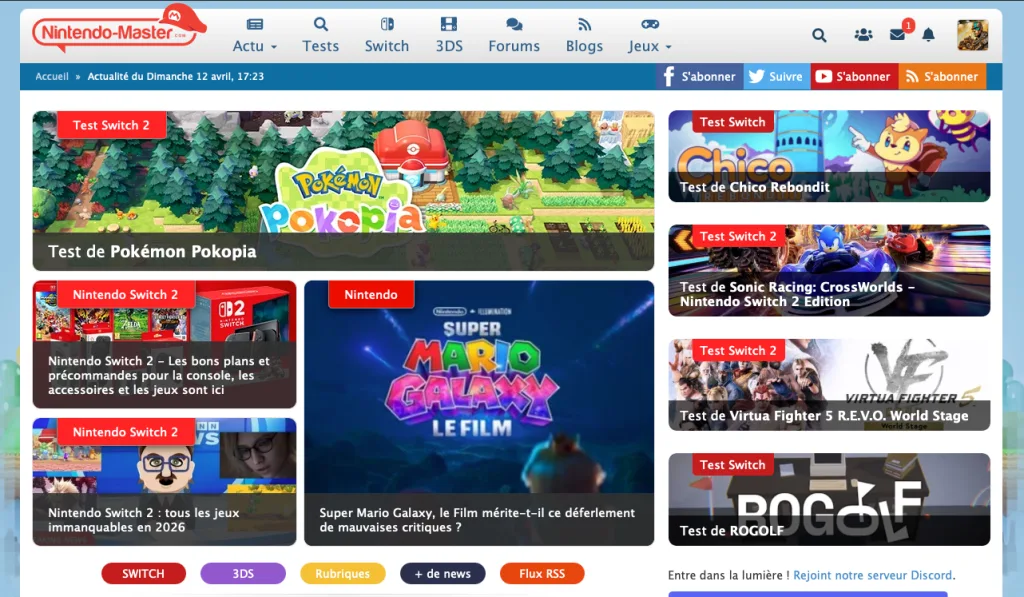
This article follows the one describing graphorrhea. In August 2019, the manager of Nintendo-Master.com (which I had completely redesigned and then left five years earlier) calls me for help: the site is collapsing in terms of traffic, plagued by a whole range of bugs, and needs another overhaul. I have just been hospitalized for the first time and have developed a full manic episode. Out of love for the site, I jump at the opportunity: it’s time to put my skills to use again. En garde!
📋 TL;DR: In short
- Mania does not create creativity; it removes barriers.
- Autism structures and refines expression.
- Together, they produce an intense creativity… but one that is sometimes chaotic and costly.
What happens next? I start coding from morning to night. Except “morning” is 6 a.m., and “night” is 3 a.m. the next day. The hospital fails to stabilize me, changes my treatment several times, and my sleep is completely disrupted. I become ultra-productive. This is unusual, because mania usually completely disorganizes me (and it will, in a way), to the point of multiplying projects and never finishing them. But when it hits one of my special interests, it manifests as an extreme speed of production.
In a few days, a few weeks, I had produced an extreme amount of work. And the work was good: incredible scores on performance testing tools, incredible optimization scores, and incredible readability scores. Google ranked my work as a kind of perfection, and it delighted me. No—it supercharged my confidence. Everything I did worked, and worked so well that it outperformed most other websites. I was thrilled. But at a cost.
A questionably real quality
I never had the opportunity to review the code I was delivering. I only had the chance to estimate its quality. But mania has an impact—and it did. Everything I wrote had to be seen through that lens. Not necessarily riddled with security flaws, but still imperfect. It was produced in a chain, never reviewed, without ever questioning its elegance. It was effective, functional, but lacked the refinement—the ultra-clean style I had taught myself without following any formal training. It was imperfect.
Graphorrhea throughout all this work
One might wonder what code is doing in an article about creativity. It’s because I was also delivering a new interface, making it cleaner, more aesthetic, and more ergonomic. I was channeling my creativity into this new visual version of the site, which would multiply its traffic once deployed. I had never produced such a successful visual result (for those who might look up the site, it is now completely outdated—you have to imagine it as it was in 2019).
That’s what mania is: ultra-productivity, but often at the expense of quality. Not always. When I started writing about my special interests, I discovered a capacity to create in a coherent and completely innate way. I didn’t need to think before writing. I wrote what I thought. And it worked. Mania didn’t create my creativity—it unleashed it. That was graphorrhea.
Thinking I was only creative during manic episodes
For a long time, that’s what I believed: I thought I was less creative when I wasn’t manic. I misunderstood the situation. In reality, I was just as creative. Mania simply removed barriers (especially social ones), and I ended up writing about all kinds of topics I would never have approached otherwise. It was fascinating, that way of engaging with things.
Many of my articles went through this manic phase, and I later had to revisit them to make them more consistent, more logical (though I left traces of grandiose ideas so they would still reflect that altered state). In fact, mania gave me an avalanche of ideas. Even when I ran out of topics, I would wake up in the middle of the night to write what was on my mind. My record was writing 50 pages in a single night—that’s extreme. And honestly, when I reread it, it sometimes happens that I don’t even understand the intention behind what I was writing.
When mania disorganizes ideas
All of this came at the cost of numerous unfinished projects. I had ideas for books that I started but never completed (though they will come to life sooner or later). Creativity, at its core, became uncontrollable and pushed me to complete exhaustion.
The reality is that, throughout all these writings, it was clear that something wasn’t quite right in my mind. I had plenty of brilliant ideas, but they were often incomprehensible from an outside perspective. An autistic friend once congratulated me on a text she found very funny, comparing it to the beginning of my book, which she considered much less readable. In my mind, though, it all made perfect sense—sense that only I could fully grasp.
A real creativity, not just manic
Another thing mania did not create, but which contributed to my artistic signature: many of my writings were infused with sensory detail. I described light, textures, sounds, melodies, and smells—sometimes with great precision. Regardless of my mental state, this precision was always present. Precision in detail, precision in word choice, precision in punctuation. That precision, that sensoriality—they are fully autistic.
Mania guided my unstoppable flow of thoughts.
Autism guided my pen.
Mania broke down my creative barriers.
Autism chose the right words.
Together, they formed a strange symphony: one improvising endlessly, the other harmonizing.
Remarkable, sometimes chaotic, but always singular.