



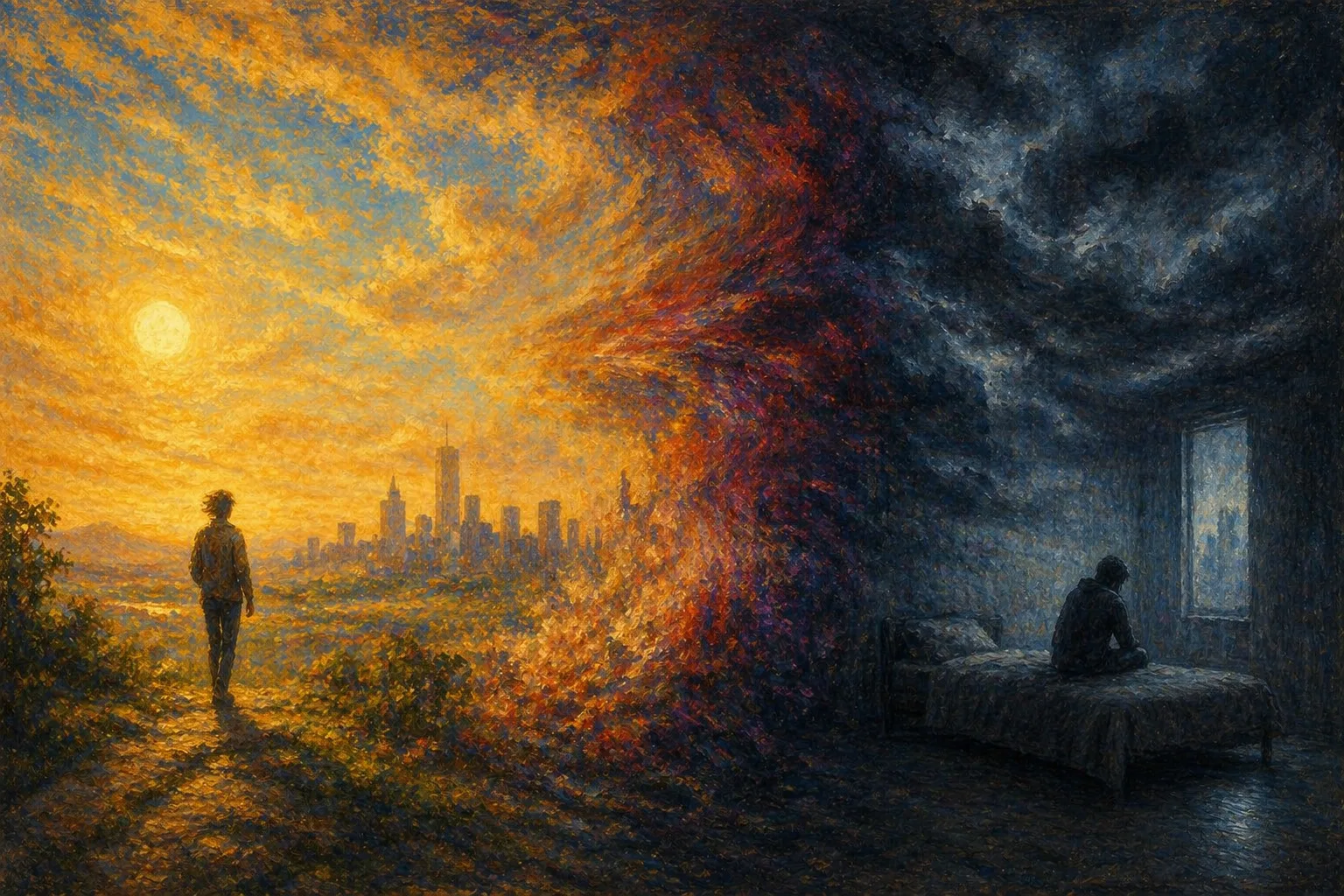
Bipolar disorder is considered one of the most severe and disabling mental disorders, as confirmed by the WHO in its ranking of the most disabling diseases. This article serves as a guide to describe the symptomatology of this still largely underdiagnosed condition.
In Brief:
- (Hypo)mania → ↓ sleep, ↑ energy, accelerated thoughts, impulsivity
- Mania → loss of control, disorganization, possible psychosis
- Depression → fatigue, loss of pleasure, guilt, dark thoughts
- Mixed → high energy + despair (very unstable state)
Bipolar disorder is characterized by an alternation of euphoric and depressive episodes, as described in the DSM-5.
This guide presents the main symptoms to help recognize them quickly.
List of symptoms of bipolar disorder
Symptoms of the (hypo)manic episode
To go further:
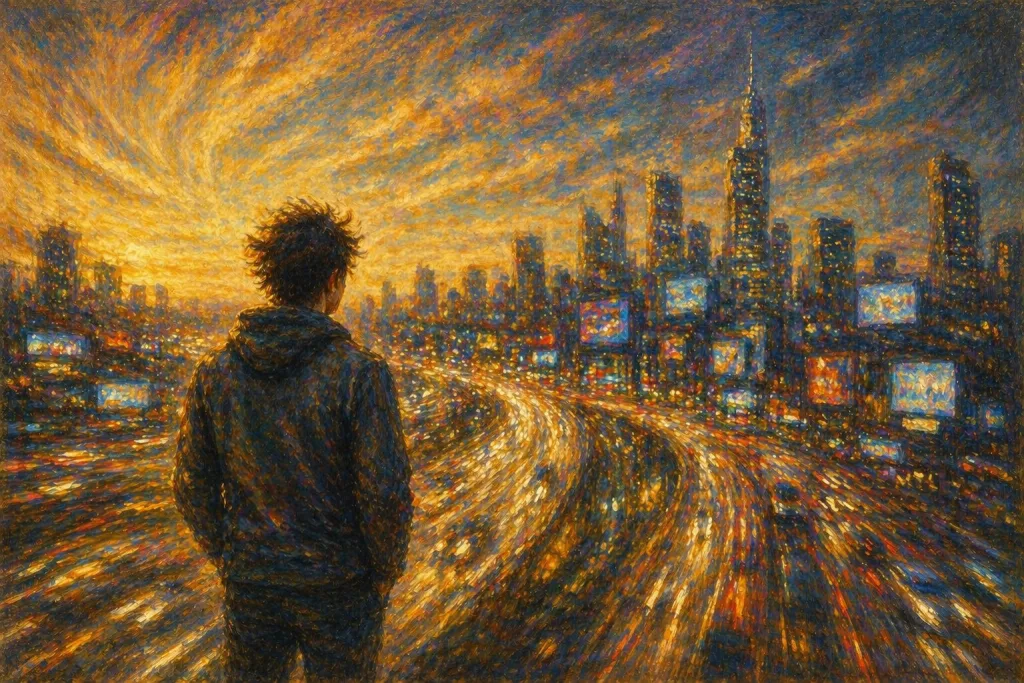
Reduced need for sleep
- Hypomania:
- Reduction of sleep by a few hours without fatigue.
- Characterized by: Refusal to sleep OR Inability to sleep.
- Mania:
- Less than 3 hours of sleep.
- The body signals a need for sleep that the brain forbids.
- Sometimes, the body is tired but the brain is not.
- Personal record → 5 days without sleeping → 1 hour of sleep → still feeling fine.
Increased energy
- Very energetic and multiplication of projects.
- Experienced in August 2025 → 2 books written in 9 days + 1 blog.
- Often mistaken as simply being extremely productive and creative.
- Psychomotor agitation (mental and physical).
- I ran at 2 a.m. for over an hour, without preparation, without feeling tired at the end.
Impulsivity
- Alcohol, risky sexual behavior, reckless spending, toxic substances, dangerous situations.
- Mania:
- Often a counterproductive multiplication of projects.
- Grandiose, confused ideas, many projects started but rarely finished.
- Projects often left unfinished:
- First manic phase → several websites never completed.
- Chaotic upon rereading.
- Endangering oneself and others.
Tachypsychia
- Strong acceleration of thought.
- Impression of sometimes thinking about several things at once without rest.
- Example → it often happens that I think about several things in parallel while a piece of music plays in the background of my mind.
- A sense of urgency to
- start activities
- or talk more than usual, even interrupting and monopolizing conversations.
- To distinguish from autism:
- A source of misdiagnosis between autism and bipolar disorder (comorbidities I discuss on the blog).
- Autistic individuals → difficulties with social codes → may interrupt conversations or infodump without realizing it.
- In (hypo)manic individuals → a symptom to be treated and uncontrollable (especially in mania).
Logorrhea and graphorrhea
- Logorrhea → Being more talkative than usual, preventing others from speaking.
- Experience: I spoke non-stop for 20 minutes upon arriving at a friend’s place.
- Graphorrhea → Being unable to stop writing (or painting, drawing, etc.). Example:
- I wrote two books in nine days.
- I drew continuously in the hospital for days.
Flight of ideas
- Jumping from one idea to another, often without connection.
- A direct consequence of tachypsychia.
- The person seems to jump from one topic to another.
Distractibility
- Everything attracts attention → a butterfly passing by, background noise, a reflection.
- May lead to misdiagnoses of ADHD (even though both can coexist).
Alteration and loss of insight
- Insight = ability to assess one’s own mental state.
- Hypomania → impaired but still partial.
- Mania → often a complete loss of insight accompanied by impaired judgment.
- With awareness of the illness → this symptom can lessen.
Self-esteem and grandiosity
- Inflated self-confidence and self-esteem, and grandiose ideas.
- Hypomania vs Mania → intensity of the symptom.
- Feeling invincible, or like a deity.
- Mania → may develop into psychosis.
Specific characteristics of mania
- Hospitalization required → manic episode.
- If psychotic features are present → manic episode.
Psychosis
- Complete loss of insight accompanied by delusions and/or hallucinations.
- Most common delusions → grandiose, mission-based, mystical, and erotomanic delusions.
- Hallucinations → often auditory (voices commenting, giving orders, sounds) & visual (shadows, lights).
- I experience psychotic traits almost systematically.
- I know I am manic
- but have no ability to question my beliefs → loss of contact with reality.
Disorganization
- Hypomania → I reinforce my routines; more productivity, efficiency.
- Mania → collapse of routines, hygiene, and dispersion in activities (e.g., I go somewhere then turn back, I take the bus without a goal).
- Mania disorganizes → it is my personal chaos.
Sensory alteration
- Mania → senses are often affected:
- Lights appear vivid, vibrant, saturated.
- Everything seems more detailed, as if in 4K.
- My world feels enhanced.
- In autistic individuals, senses are already affected.
- A person hypersensitive to visual stimuli may feel amazed by the world.
- Seeking visual stimulation.
Differences between hypomania and mania
- Hypomania → often seen as productive, with overall functioning preserved and moderate intensity.
- Mania → chaotic, extremely intense and highly disabling, inability to function.
Symptoms of the depressive episode
To go further: Bipolar depression — definition and symptoms.
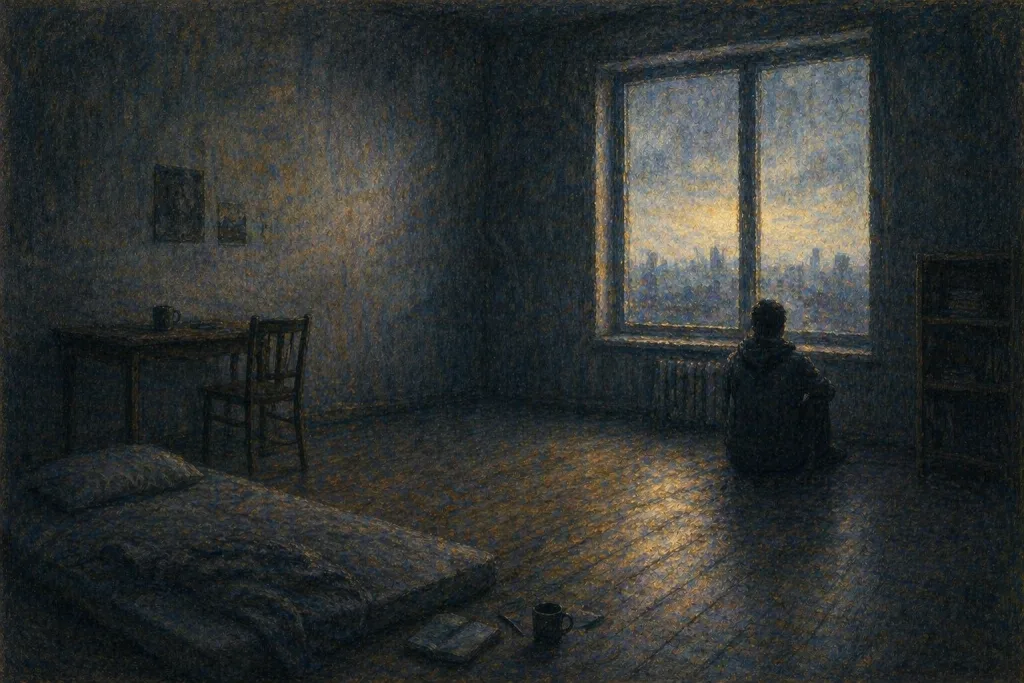
Depressed mood
- Depressed mood → sad or anxious.
- At first → I have repeated crying spells.
- As it intensifies → I feel like I no longer have the energy to cry.
Anhedonia
- Loss of interest OR pleasure.
- In autistic individuals → possible loss of pleasure even in their special interests.
- Concretely → I do nothing anymore, I just wait for the day to pass.
- Not to be confused with autistic burnout (see here).
Weight gain or loss
- I have already lost 8 kg in one month from no longer eating.
- Results from loss of motivation.
Insomnia or hypersomnia
- Often hypersomnia → I sleep 12 to 14 hours per night.
- I stay in bed for the rest of the day.
Psychomotor agitation or retardation
- Agitation:
- Moves constantly, difficulty staying still.
- Thinks about too many things (≠ different from tachypsychia).
- Retardation:
- Thinks and processes more slowly.
- Functions in slow motion.
- Must be noticeable by others.
- Psychomotor retardation is often seen in bipolar disorder.
- For me → feeling slowed down, I walk more slowly, I respond more slowly.
Fatigue
- With lack of energy.
- Severe fatigue → non-restorative sleep.
- No longer has the energy even for simple tasks (for me → taking a shower, shaving).
Feelings of worthlessness / excessive guilt
- Devalues oneself, loses self-esteem and self-confidence.
- Guilt:
- Excessive, overwhelming, irrational.
- Examples:
- “I am a bad person.”
- “I am a burden to others.”
- “I am selfish.”
- These are the kinds of thoughts that weigh on me when I am depressed.
Decreased concentration OR indecisiveness
- Difficulty making decisions, even simple ones.
- Difficulty concentrating (≠ mania).
Dark/suicidal thoughts
- Dark thoughts:
- “I should not have been born.”
- “I wish everything would stop.”
- Suicidal thoughts/planning/attempts.
Symptoms of the mixed episode
To go further: Mixed episode — definition and symptoms.
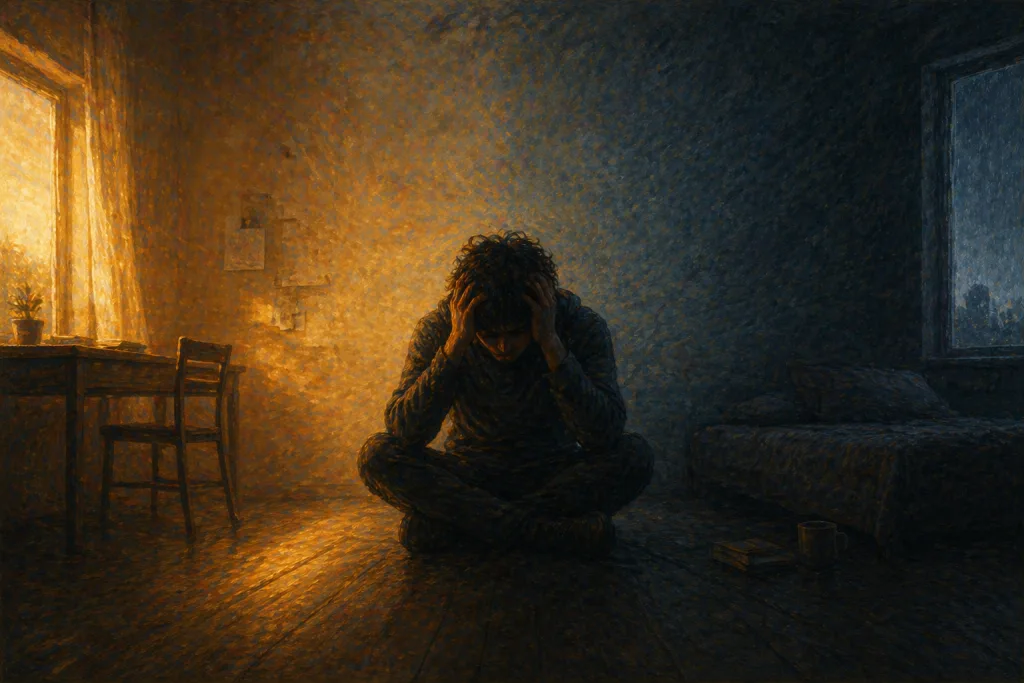
- (Hypo)manic episode with ≥ 3 depressive symptoms.
- High energy + despair → most unstable state.
- In my case:
- I experience it as the most terrifying episode of bipolar disorder.
- Suicidal thoughts overwhelm me from morning to night.
- I have the energy to be afraid of these thoughts.
- A real trauma.
- Autistic individuals seem more prone to mixed episodes.
Recognizing these states is already a way to regain some control.
Hypomania may seem useful.
Mania is always destructive.
Both come at a cost.
If these words help you understand yourself, you can support the project ☕