



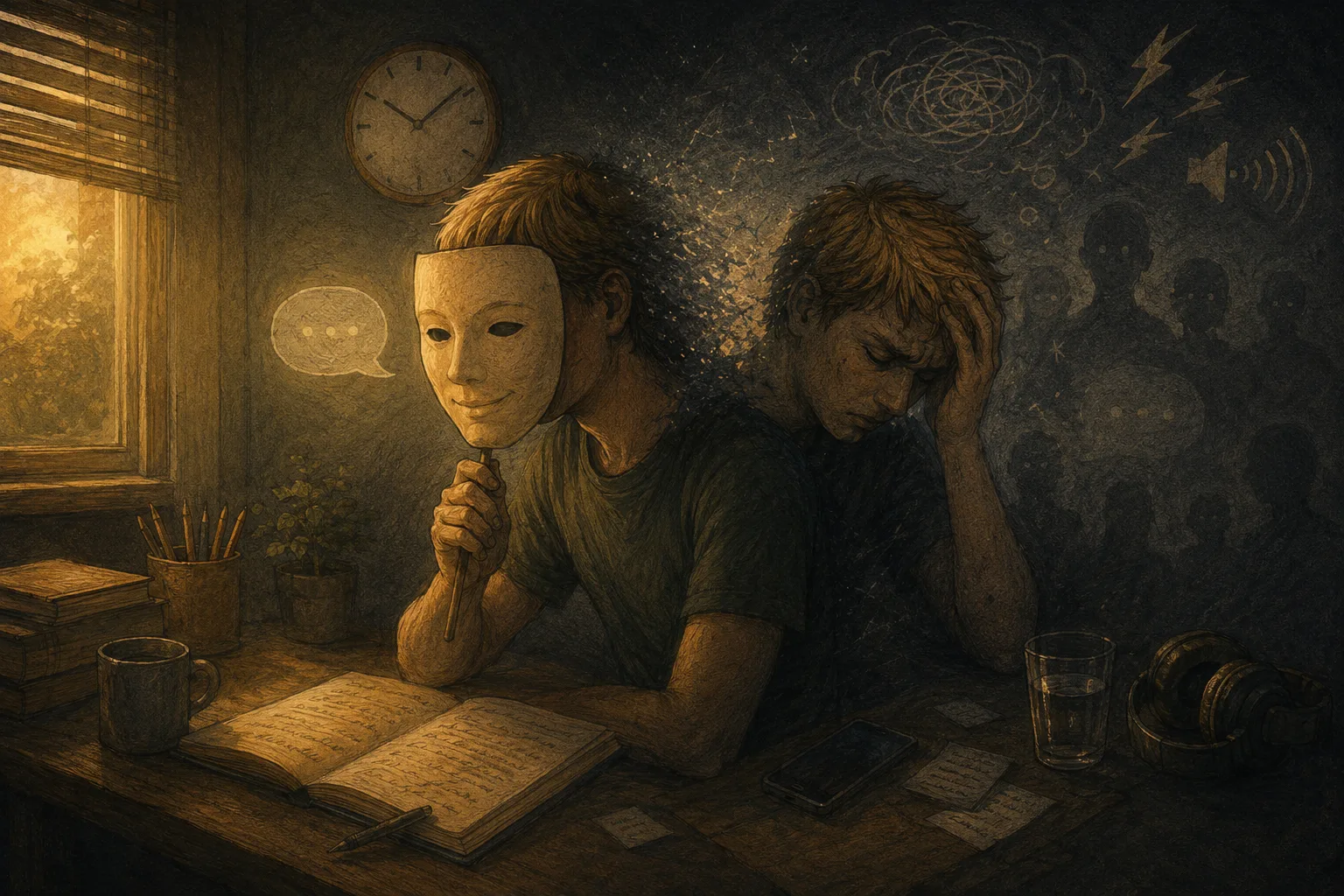
Many autistic people spend years appearing to function normally in the eyes of others. Yet this apparent normality often relies on an invisible effort: autistic masking, also known as social camouflaging. This mask can sometimes help a person adapt more easily to the outside world, but it comes with an often underestimated cost: chronic fatigue, overload, and sometimes autistic burnout. In this article, I explain what masking really is, why it appears so early for some people, and how it can eventually become a trap.
Two factors are often involved in autistic burnout: sensory exhaustion and the cognitive cost of autistic compensation. In many cases, this mask develops very early in an autistic person’s life as a way to function in a world that is not designed for them.
Masking — creating a social mask — is particularly observed among autistic people without intellectual disability. Some articles and personal accounts also suggest that the ability to mask may become stronger as IQ increases.
In Brief:
- Definition: Autistic masking involves hiding certain autistic traits in order to adapt more easily in social situations.
- Purpose: It often acts as a survival strategy to avoid rejection or make social interactions easier.
- Cost: Maintaining this mask requires constant effort, which can lead to fatigue, overload, and exhaustion.
- Main consequence: When it becomes permanent, masking can contribute to autistic burnout.
- Key point: Reducing the mask is sometimes more realistic than trying to eliminate it completely.
Who practices masking?
In women: social pressure
This can also be observed in women, who are often encouraged to begin masking from childhood due to social pressure within their environment (Hull et al., 2020; Cook et al., 2021). Social expectations toward women are often different from those placed on men. Jeanne talks about this in her article on autism in women.
Cognitive abilities and compensation
Some studies suggest that certain cognitive abilities may facilitate masking. In particular, executive functioning and certain social compensation strategies appear to play a role (Hull et al., 2020; Lai et al., 2017). However, the relationship between masking and IQ remains debated and no clear consensus exists today.
People with high intellectual potential may sometimes develop more elaborate compensation strategies, which can create the impression of more effective masking. However, the direct relationship between IQ and autistic camouflaging is still debated in scientific literature.
My earliest memories of masking go back to around age 5 or 6. I noticed that other people behaved differently, and I would model my own behavior after theirs, often with mixed success.
Autism with or without intellectual disability: different forms of masking
I mention these two profiles, but masking also exists among autistic people with intellectual disabilities. However, it often appears to be less frequent, less elaborate, and less enduring than in the rest of the autistic population.
This is also why I often bring it up when I hear phrases such as “real autistic people” (implicitly and incorrectly meaning “autistic people with intellectual disabilities”).
I then explain that there is no such thing as a “real” or “fake” autistic person. Instead, we observe different difficulties depending on whether the person has an intellectual disability or not. While one person may struggle more with autonomy, another may experience autistic burnout and exhaustion related to masking.
I’ve already heard autistic people say they felt like impostors because they did not perceive themselves as disabled. I usually ask them whether they mask. In those cases, I answer that masking itself can already be a form of disability: it creates significant fatigue and can contribute to autistic burnout.
Definition of masking
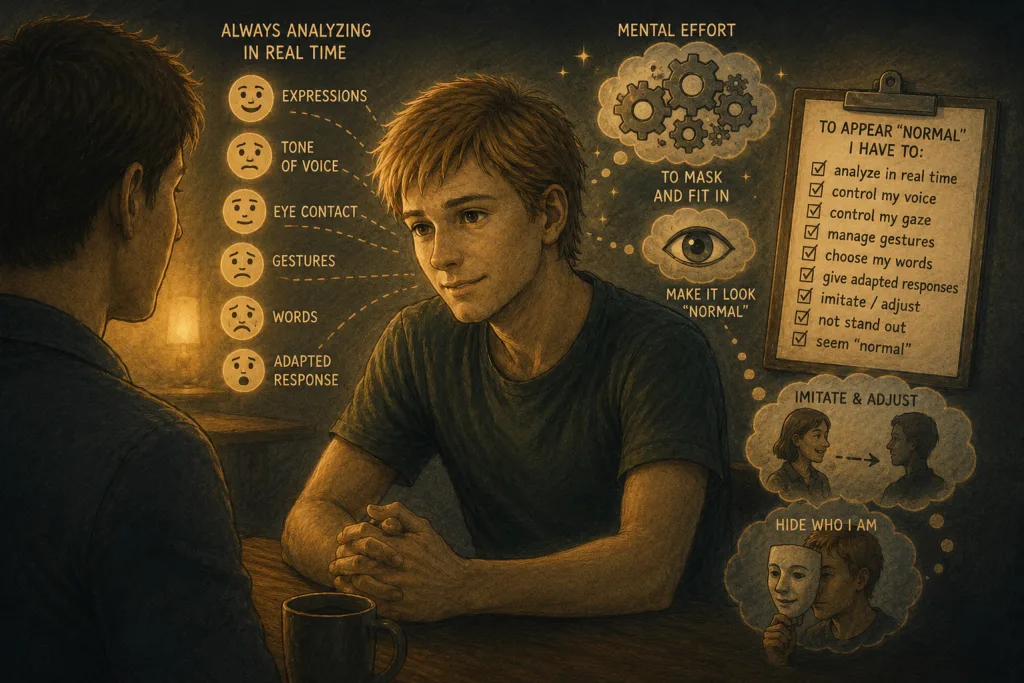
For many people, one of the biggest contributors to autistic fatigue is this permanent social mask. By masking, I mean the collection of processes an autistic person uses to blend into their surroundings and make their difficulties disappear — or at least reduce them. This often comes at the cost of constantly analyzing the environment in real time to adapt social responses and behaviors, with the goal of appearing as allistic as possible, or at least as little autistic as possible.
Masking is not always conscious. Many autistic people learn to imitate social behaviors from childhood without realizing they are playing a role. Sometimes the effort only becomes visible in adulthood, or after a burnout.
This implies a very significant cognitive effort. The person may end up in a state of constant hypervigilance in order to adapt to others. In some cases, this effort may have started years or even decades earlier.
Manifestations of masking
This form of social camouflaging can take many different forms depending on the autistic person, but some recurring patterns often appear. A short list says more than a long explanation:
- Real-time analysis of the other person’s nonverbal communication: facial expressions, voice, tone, intonation
- Replicating these observations by mirroring smiles, laughter, or reactions
- Maintaining eye contact (which paradoxically can reduce attention to the conversation itself)
- Using movements to signal engagement in the discussion — sometimes too much, or not enough (for example: excessive nodding)
- Suppressing stims/stereotyped behaviors in front of others
- Suppressing any autistic trait that might appear unusual to society
- Avoiding interaction when a special interest is on their mind to avoid monopolizing the conversation
In short: the autistic person is acting in a play without ever leaving the stage — or at least not until they are finally alone again.
Causes of exhaustion
Burnout originates in total exhaustion, which itself can emerge after masking becomes too intense. Several types of overload can contribute to this:
- cognitive load
- Based on the previous section, we can understand that masking requires an extremely detailed analysis of both the environment and social interactions.
- This involves not only observing, but also correcting (especially for future situations) and anticipating events in order to respond appropriately.
- The effort is so constant and so present that it can sometimes create a disconnect during interactions. I sometimes become so focused on analyzing the other person’s nonverbal communication — and my own — that I forget to actually listen to them.
- emotional load
- Fear of not doing things correctly…
- Fear of being noticed (many people dislike being the center of attention — and even more so being perceived as strange)
- sensory load
- Masking often requires enduring overwhelming internal and external sensory stimuli
- Some situations prevent a person from protecting themselves, which can eventually lead to a crisis if left unmanaged
When the mask works too well
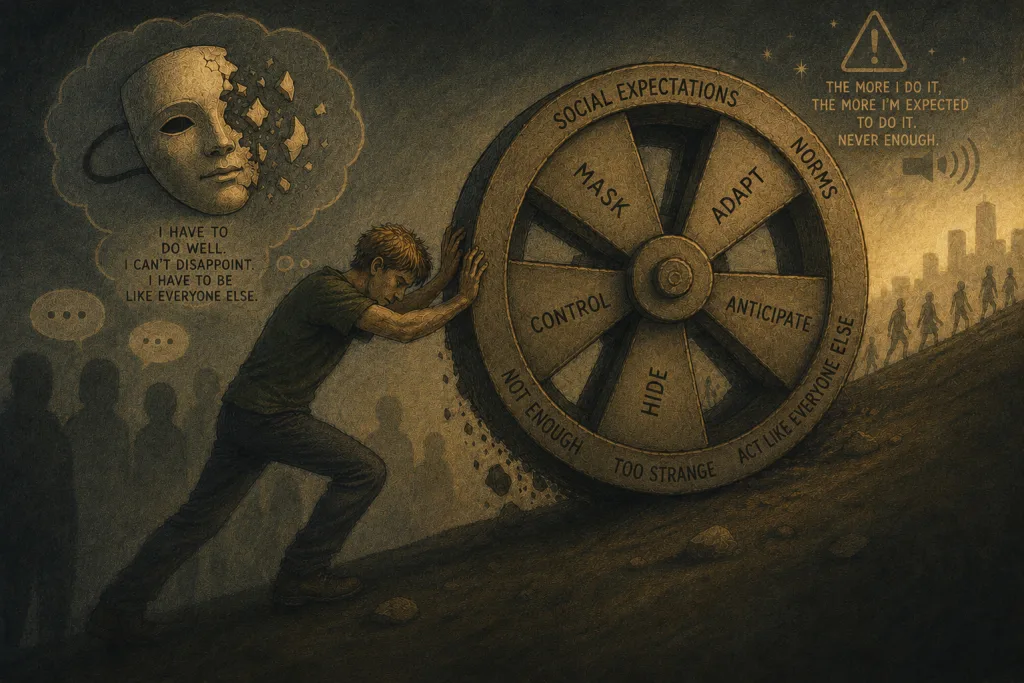
One issue consciously or unconsciously experienced by many autistic people is their ability to mask so effectively that society stops adapting altogether. The mask is already a form of adaptation. So when society does not adapt in return, the process becomes one-sided and continues escalating until it reaches a breaking point: autistic burnout.
This is a phenomenon frequently discussed online by autistic people who end up carrying most of the burden of adaptation without reciprocity.
To be clear: I am not saying that the world never adapts to autistic people. Rather, adaptation often comes at a greater cost for autistic individuals than for those around them (partly due to factors such as mental flexibility, which can be more challenging in autism).
Because neither the mask nor autism itself are always recognized, expectations can continue increasing and push autistic people to strengthen their social mask even further — eventually leading them toward autistic burnout.
The delayed first autistic burnout
I experienced my first autistic burnout at age 25. Two years later: another burnout. One year later: yet another. Shorter this time. That led me to ask myself a question: “How did I manage to maintain my social mask for 25 years when the others happened so much faster?” To answer that question, it needs to be broken into parts.
A late first burnout
The delayed appearance of a first burnout (many experience it around their twenties or thirties) is actually relatively easy to explain.
Childhood and adolescence are structured: school schedules, activities sometimes encouraged by parents, little autonomy required, and living with family.
Adulthood often marks the beginning of much greater independence. Many people suddenly become almost fully independent after moving out alone. Administrative responsibilities appear, university life becomes less predictable, or people enter the professional world where all the social rules change.
Maintaining a social network becomes necessary, intimate and romantic relationships become more complex. In concrete terms, all of this requires a more effective social mask — and therefore a much more exhausting one over time. In reality, the autistic person may simply have accumulated years of fatigue. It remained silent because life still offered more support and structure, particularly through family.
Why later burnouts can happen faster
Like certain syndromes — and even autistic crises, depressive episodes, or bipolar (hypo)manic episodes by extension — the brain can become sensitized to burnout. Over time, and with repeated episodes, it may begin triggering this response more easily.
For others, the first burnout happens long before an autism diagnosis. In those cases, the person does not always understand what led them there — including the role of masking. As a result, they may return to the same habits and unknowingly increase the risk of another burnout.
That’s one of autism’s strange quirks: the difficulty of understanding one’s own needs and struggles well enough to build survival tools.
The solution: stop masking?
Masking as a survival strategy
Since this article may seem to associate masking with inevitable autistic burnout (which is obviously not always the outcome), it raises an important question: should people stop masking? To answer that, the phenomenon itself needs to be examined more carefully.
The mask can become so deeply rooted in daily life that separating from it becomes difficult. For many people, it functions like a life jacket — something that helps preserve and sometimes build social relationships.
Can you really stop masking?
Some would argue that if a mask is necessary, then the interaction itself may not be worth pursuing.
But that oversimplifies the issue. In professional settings alone, not masking can become a form of social suicide with colleagues. Not all countries or environments are equally accepting of autism.
Likewise, at the beginning of a romantic relationship, masking may feel like the only way to move forward. If you think about it, the process of seduction already involves a degree of performance and presentation. Masking can simply become an extension of that.
Reducing masking rather than eliminating it
I’m not talking about complete masking here, but at least partial masking. Many autistic people consciously choose to reduce their masking as much as possible once they understand what it costs them.
I’m not recommending maintaining a social mask indefinitely — that would likely be harmful. I’m simply explaining how some people manage to function by reducing masking without eliminating it entirely.
Stop masking, yes. But how?
Identity confusion
At some point, many people — regardless of gender — reach a stage where they no longer clearly know what belongs to their identity and natural way of functioning, and what belongs to the mask. Many testimonies describe a deep confusion: people feel like they no longer know who they truly are because the mask has become embedded in everyday life.
Among women, this confusion can sometimes be misinterpreted as a symptom of borderline personality disorder, where self-image is often unstable. This is why questioning becomes so important: similar experiences may exist, but the causes behind them can differ greatly depending on the diagnosis.
When this mechanism lasts for years, it can eventually lead to profound exhaustion. My own experience illustrates this fairly well.
Personal experience
Before being diagnosed as autistic, I had first been identified as intellectually gifted. I was told at the time that this explained the social mask I had mentioned during my first appointment — incorrectly.
The origins of my masking
I already knew I masked, but I called it “chameleoning.” For the first 21 years of my life on this planet — one that often felt foreign to me — I had built a mask very early on and continuously reinforced it.
The intense episode that broke the mask
A few months before my autism diagnosis, I entered a vicious cycle of extreme socialization because I wanted to meet new people. People constantly told me: “You should go out more.” So I took it literally. To the point where I started going out every evening for hours, with friends, meeting complete strangers.
You can probably imagine the damage:
- extreme socializing without rest
- meeting complete strangers and struggling to understand how to interact with them
- constant sensory chaos from spending days surrounded by large groups of people
Then one day, my brain simply could not keep up anymore.
I experienced a severe meltdown caused by sensory and social overload — one that abruptly resulted in my first autistic burnout.
My burnout: the result of masking
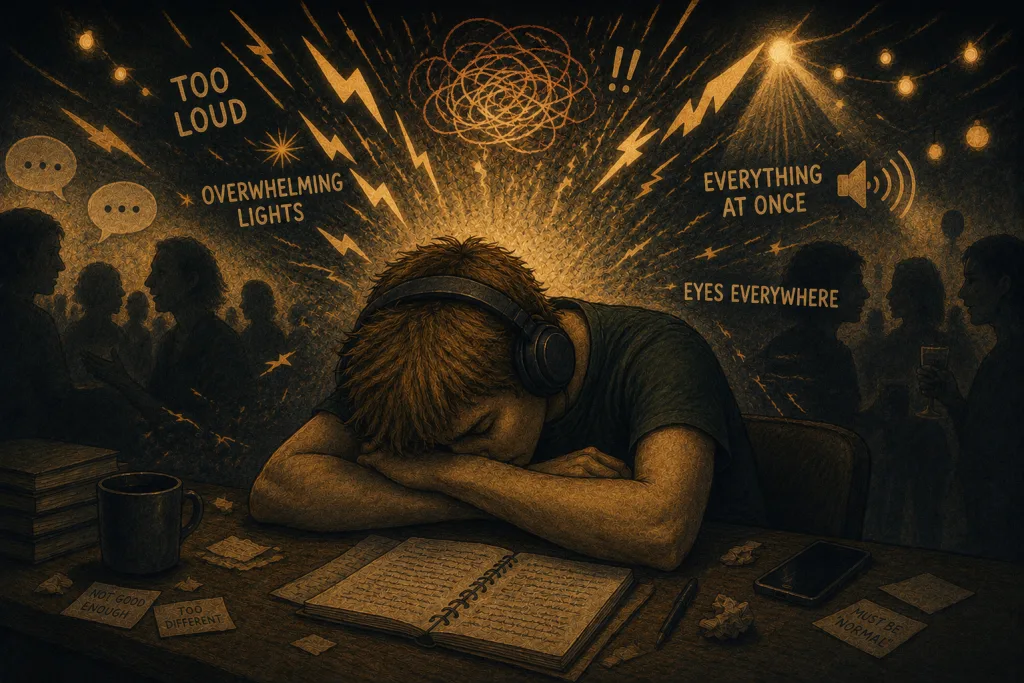
Overnight, I felt a level of exhaustion unlike anything I had experienced before — far beyond the fatigue I had become used to during depressive episodes. My mask collapsed without warning. My autism suddenly became much more visible. My rigidity intensified, and every outing ended in a shutdown and occasionally a meltdown. Sometimes both.
For two decades, I had built an entire system designed to help me blend in with everyone else. And suddenly, that system collapsed. I felt as though I could no longer function at all, and I needed to understand what had pushed me to create a mask that ultimately proved useless — because in the end, it had broken me.
The masking loop
Little by little, I regained my ability to function socially. I stopped hiding my stims and rituals, which, in reality, mostly ended up amusing the people around me.
However, over time, my mask gradually returned — partly because of a new job and partly because of a girl I liked. An afterwork event filled with loud music and bright lights naturally led me toward a second autistic burnout.
The vicious cycle of masking
This is what I mean when I describe it as a loop: One mistake many people make after burnout is returning to their old masking habits, which means running the risk of another burnout. I put an end to that cycle two years ago. Now I walk through the streets wearing sunglasses and noise-canceling headphones, stimming, looking at the ground, without worrying about how others perceive me.
Reducing the mask without disappearing socially
It took years, but I finally reached a point where I feel aligned with my autistic way of functioning. I still mask sometimes. I still occasionally hide my stims or pay attention to how I interact — especially in professional settings — but I do it without pushing beyond my limits.
Masking is not always avoidable. In some social or professional situations, it remains a survival strategy. But when it becomes permanent, adaptation can turn into a trap and eventually lead to autistic burnout.
The early signs are not always easy to recognize. I have detailed the most common manifestations in my article on the 10 signs of autistic burnout.
If masking has already contributed to autistic burnout, recovery often involves reducing overload, adapting your environment, and learning to respect your limits.
Learning to reduce the mask, even partially, is often an essential step toward preserving energy and better understanding oneself.
FAQ about autistic masking
Some people realize they are masking when they consistently feel exhausted after social interactions, constantly monitor their own reactions, or feel as though they are playing a role. Others only discover their masking after an autism diagnosis or an autistic burnout.
No. Many autistic people learn to imitate certain social behaviors very early in life, sometimes from childhood, without realizing they are building a mask. In some cases, the effort only becomes visible in adulthood.
Some studies suggest that autistic women may develop more social camouflaging strategies, partly due to different social expectations. However, masking is not exclusive to women and can affect all autistic profiles.
Masking does not automatically lead to burnout. Many people mask for years without developing one. The problem mainly arises when the cost becomes permanent.
Not always. For some autistic people, masking remains a survival strategy in certain social or professional situations. Many people instead aim to gradually reduce their mask in order to preserve their energy.
Masking can hide certain difficulties, but its cost can be significant: fatigue, overload, and a loss of identity or self-understanding. Some autistic people experience it as a form of invisible disability.
In Brief:
- Definition: Autistic masking (or autistic camouflaging) refers to strategies used consciously or unconsciously to hide certain autistic traits in order to appear more socially “normal.”
- Initial purpose: It often acts as a survival strategy, helping people adapt, avoid rejection, or make social interactions easier.
- Main cost: Maintaining this mask requires significant cognitive, emotional, and sensory effort that can lead to chronic fatigue.
- Common manifestations:
- constant analysis of nonverbal communication
- imitation of social behaviors
- suppression of stims
- controlling eye contact, voice, or reactions
- Link with burnout: When it becomes constant, masking can turn adaptation into a trap and eventually lead to autistic burnout.
- Key point: Completely stopping masking is not always possible. For many people, learning to gradually reduce the mask is often more realistic than trying to eliminate it entirely.
