



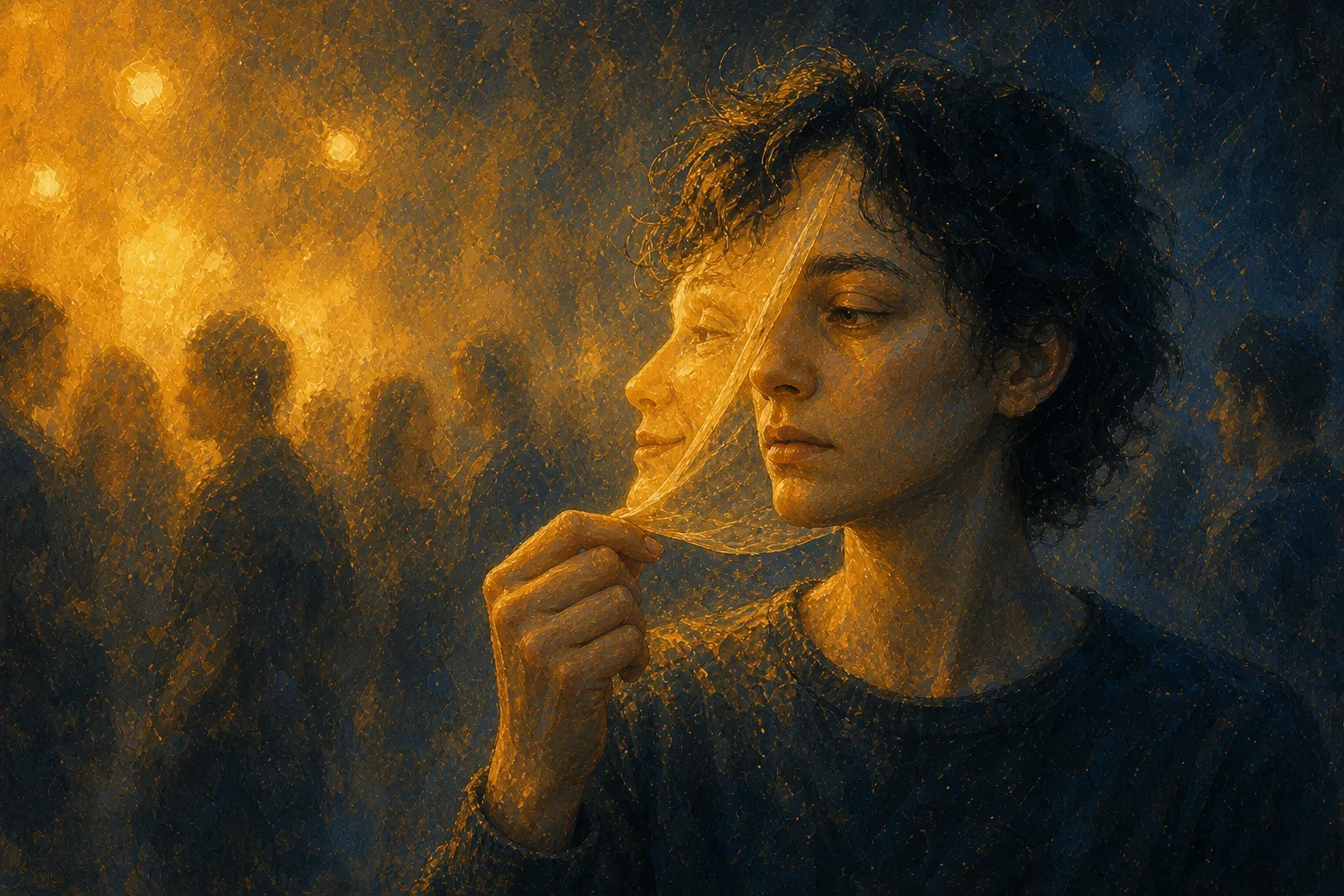
Masking, sometimes called social camouflaging, consists, for autistic people, in compensating for their difficulties across every affected area of their lives in order to blend more easily into society. In practice, it means making their difficulties—and therefore their differences—invisible. A significant number of autistic people rely on these mechanisms—plural, because there are many of them. Often from a young age. Sometimes from early childhood. That was my case.
In psychiatry, the term most commonly used is “compensation” for one’s difficulties. Within the autistic community, however, people tend to speak of masking because the aim is not exactly to overcome those difficulties. The aim is practically to kill off one’s autistic traits in an attempt to make one’s behavior conform to that of allistic people.
A systematic review of autistic camouflaging describes it as a response driven primarily by social norms, the desire for acceptance, and the fear of rejection.
In Brief:
- Definition: autistic masking refers to the strategies used, consciously or unconsciously, to hide autistic traits and meet social expectations.
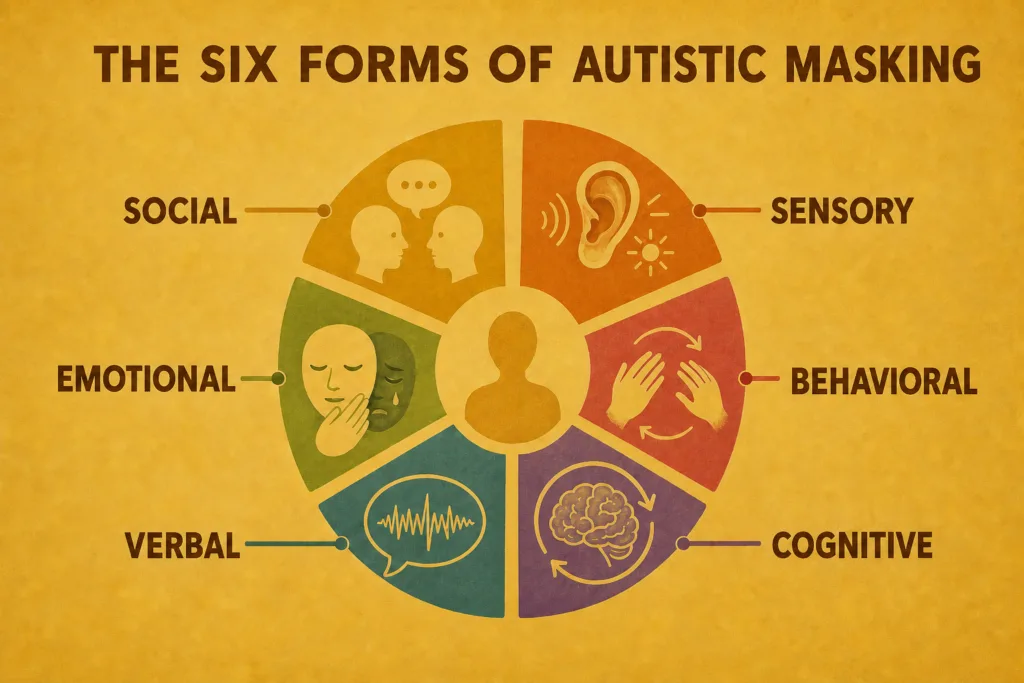
- Forms: masking can be social, sensory, emotional, behavioral, verbal, or cognitive.
- Signs: preparing interactions, imitating others, suppressing stims, or feeling exhausted after socializing can indicate significant masking.
- Benefits: masking can facilitate certain relationships, professional integration, or protection from negative reactions.
- Cost: when it becomes permanent, it can lead to overload, loss of identity, unmet needs, and autistic burnout.
- Key point: gradually reducing masking while expressing one’s needs is often more realistic than trying to eliminate it completely.
The different types of masking
Masking in autism can affect several—or even all—areas of a person’s daily life. It is commonly referred to as social masking because its purpose is to blend in and become invisible. In reality, however, masking can be social, sensory, emotional, behavioral, verbal, and cognitive. Here is a detailed description of each form.
Social masking
To explain precisely what social masking involves, we must first remember that autism is primarily characterized by differences in social interaction and communication. Unspoken social rules, social conventions, and ways of interacting with others are the areas most affected. These criteria are essential to an autism diagnosis.
Observing and reproducing social behaviors
Social masking therefore consists primarily of behaving according to norms that are not one’s own. Learning social conventions and following them without truly understanding them is often one of the first strategies adopted. For many autistic people, however, social masking goes much further: in numerous personal accounts, they describe carefully—and sometimes meticulously—observing allistic behavior in order to reproduce it as accurately as possible.
This can manifest, for example, as forced eye contact. You know, that stereotype that leads professionals to tell people struggling to obtain a diagnosis that they cannot be autistic because “they make eye contact.” I am also thinking of smiling, nodding, laughing, and using learned and forced facial expressions, all with the aim of appearing to interact like any other “normal” person.
Preparing interactions with social scripts
Social masking also includes all the scripts we construct in our minds to prepare for interactions. Before arriving at someone’s home, I always have a conversation prepared. A friend was once even offended that I needed to do this with her. The thing is, I do it with everyone. Scripts are also built over time to help manage recurring conversations. For me, there is “Guadeloupe,” which comes up whenever someone asks where I am from and always consists of the same sequence of answers.
Sensory masking
It is discussed less often, yet it is one of the forms of masking that makes the greatest difference. In my case, it was even the one that surprised those around me most after my diagnosis, because “I could manage it before.”
I am referring here to all the strategies used to endure sensory stimuli, whether external or internal: sitting through a two-hour meal in a noisy restaurant; tolerating hugs (or refusing them without appearing “weird”) or even cheek kissing; wearing clothing with an irritating label; or remaining in a room filled with overpowering smells from perfume, incense, or food. All of this sometimes comes at the heavy cost of autistic crises, or at the very least steadily increasing exhaustion.
Other people often fail to notice because autistic people themselves may not realize how much they are compensating in those moments. Many autistic people are aware of their sensory hypersensitivities, but before receiving a diagnosis, many assume that everyone experiences the world in the same way.
Emotional masking
Emotional masking is discussed less frequently, so it is worth examining in detail. Autistic people often experience a greater emotional load. According to a meta-analysis published in 2019, nearly half of autistic people (49.93%) may also experience alexithymia, meaning difficulty identifying, understanding, and expressing emotions, compared with approximately 5% of the non-autistic people studied.
When a person can no longer manage this emotional flow or load, it is known as overload. Overload can lead autistic people to experience a meltdown, an autistic crisis that manifests as an emotional collapse or explosion. Emotional masking then comes into play: internalizing as much as possible to prevent the crisis from happening. As I have grown older, I have developed this kind of “delayed crisis.”
More broadly, even without reaching that breaking point, many autistic people learn to hold back their tears or maintain a neutral expression to conceal emotional distress. I know autistic people who are particularly prone to this form of compensation because they were taught as children that “men don’t cry.” And this is not merely a rule belonging to cavemen: it still exists in some families and cultures today.
Behavioral masking
This one is simple: it means masking restricted and repetitive autistic traits.
An autism diagnosis includes a category dedicated to restricted and repetitive behaviors: stims, routines and rituals, and special interests. These are often among the behaviors that allistic people notice most—those that make an autistic person appear strange or unusual.
Masking one’s stims
Many autistic people learn to reduce or completely suppress their stims. I remember beginning to do this when I was around six years old. Whenever someone pointed out that one of my stims was strange, I eliminated it, often replacing it with a more discreet one. Those that bothered people less remained or changed form: instead of simply rocking, I began rocking in my chair.
Giving up routines and rituals
My rituals took longer to disappear. I walked across tiled floors in an unusual—but highly methodical—way until adolescence, before suppressing that behavior as well and reserving it for solitary walks.
Some autistic people go so far as to hide their routines or force themselves not to complete them so that they can conform to external demands. All these strategies can generate considerable anxiety.
Hiding or modifying special interests
Finally, there are special interests. Some autistic people, particularly women, develop special interests that appear less unusual—though they remain just as intense—to conform to society’s gendered expectations. They may begin doing this in early childhood. Others may also learn, as they grow older, to develop special interests that align more closely with social expectations.
I was fascinated by Code Lyoko (a French cartoon) to the point that I made birthday cards inspired by it until I was 14. I gradually replaced it with my passion for programming, which had begun when I was 11. Programming impressed people. Code Lyoko, Nintendo, and Spider-Man impressed them much less.
Behavioral masking can also involve learning to stop unsolicited infodumps, show an interest in other people, ask them questions, and so on.
Verbal masking
This form of masking consists of adapting one’s way of communicating to that of allistic people—and, dare I say it, sometimes even to that of other autistic people. I will return to this point.
Changing the way one speaks
Verbal and nonverbal communication can be affected to varying degrees in autism. Commonly observed features include a monotone voice or, conversely, a highly melodic one; a faster or more measured speaking pace, like a documentary narrator; and unusual turns of phrase that can sometimes sound almost formal.
Masking therefore involves adapting one’s prosody, tone, intonation, rhythm, and even choice of words. I still remember being mocked at school because I had chosen an extremely literary phrase to convey a message to other people. And I can assure you that saying “the message I am expressing to you” will also guarantee some ridicule—or at least a little teasing.
Learning to balance a conversation
Why adapt communication when speaking with autistic people? Because if I did not, I would probably communicate mainly about whatever interested me and never think to ask the other person how they were or what they were passionate about. But the other person often has the same ability, so it generally works rather well between us.
Many allistic readers probably found that sentence perfectly normal. Yet this behavior does not come naturally to everyone. For many autistic people, asking questions, changing the subject spontaneously, or maintaining balance in a conversation is something that must be learned.
Cognitive masking
The choice of term is not self-evident. This is probably the type of masking that even autistic people think about the least.
In practice, it involves questioning, analyzing, ruminating, and anticipating social situations. Many autistic people encounter social situations that are difficult to navigate and sometimes have no way of knowing whether they handled them appropriately. They may be mocked or receive suspicious or puzzled looks. That is enough to create a mental problem that must be solved, and that will not allow the autistic person to rest until it has been resolved.
Understanding or resolving one social situation also makes it possible to anticipate the next one more effectively. The problem is that social situations are rarely identical. Autistic people are often masters of incorrectly generalizing and applying a solution learned in one situation to every subsequent one.
They therefore continue absorbing new use cases and adding them to their collection of social problems. This process is particularly demanding and can exhaust—or even completely drain—the person.
How masking develops from childhood
Many autistic people begin masking very early, sometimes as early as childhood. Women are frequently mentioned among those most affected, though not exclusively, as are possibly gifted people. The reasons differ between the two groups.
Women: masters of masking
Women often grow up in a gendered environment—or, more accurately, a highly gendered society—in which they are taught from a very early age to behave in a particular and “proper” manner according to that same society. This education begins in early childhood, leading them to develop a social mask relatively early. As they grow older, this mask becomes increasingly elaborate and eventually turns into reinforced concrete: by adolescence, they may be almost indistinguishable from allistic people… almost. Society often still notices that they are atypical, without knowing exactly why.
Several studies suggest that autistic women engage in more social camouflaging. A systematic review published in 2021 concluded that the available evidence broadly supported this idea while also highlighting the daily cost of these strategies. More recently, in a study involving 502 autistic adults, women reported more camouflaging than men across all three dimensions measured.
The giftedness hypothesis
Another commonly discussed case concerns gifted people. Some clinical hypotheses suggest that greater cognitive abilities could facilitate the learning of compensation strategies. However, the direct relationship between giftedness, IQ, and masking remains debated and is not currently supported by a scientific consensus.
This form of masking may rely on several mechanisms. The first is the ability of gifted children to identify implicit rules quickly. Without necessarily understanding them, they may find it easier to absorb and follow them blindly.
Their memory is often stronger, allowing them to memorize the rules of verbal and nonverbal communication more effectively and sometimes to develop social scripts. They may also display greater metacognition—the ability to understand, or at least question, their differences and therefore learn to manage and conceal them.
Above all, many gifted children are perceived as highly intelligent people whose difficulties are met with less tolerance. This can push them to compensate more effectively.
That last point played an enormous role while I was growing up: I was always expected to know how to act—even when something was wrong but socially accepted—how to behave, and how to succeed. I remember some of the first times I masked, badly: a girl congratulated me on a drawing I had made in primary school. I replied, “I know,” instead of “thank you,” but then complimented her drawing even though it was not particularly good. I also tried wearing clothes and bracelets similar to those worn by a small group of children, without success.
From the age of five until my first autistic burnout, I masked constantly. I could tell that something was wrong, but I did not know what.
So I copied.
I “chameleoned,” as I used to tell a select few people.
Signs that you are masking
If personal accounts are anything to go by, several recurring signs can be identified.
Adaptive behavior
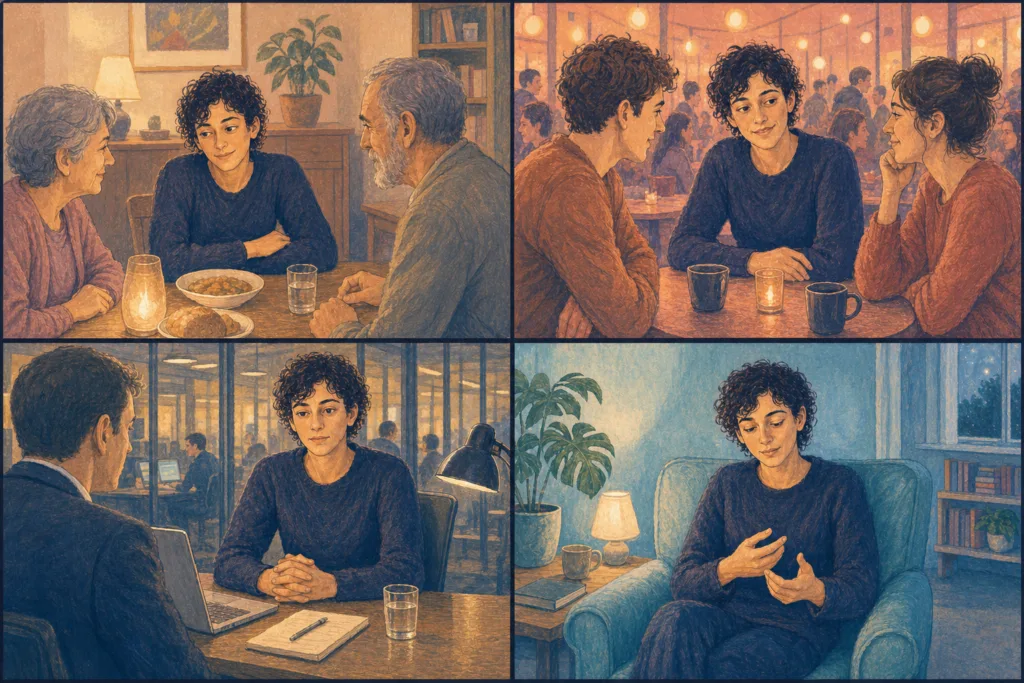
The first was directly raised with my mother during my ADI-R assessment: did I behave the same way with my family as I did with my friends? I already knew the answer—and found it intriguing. As it turned out, so did my mother. Yes, I behaved differently depending on whether I was with my family or my friends. At first, I also thought that I behaved differently with different groups of friends, although I was told that I did not.
The reason was simple: with my family, I had learned to compensate, but not nearly as much. It was not necessarily required for them to continue liking—or tolerating—me. With friends, things were very different. I had to learn the social codes and therefore behave differently around them in order to be accepted. And it worked, much to my surprise.
Feeling relieved when you are alone
As soon as I was alone, I would “become autistic again.” In fact, Tony Attwood—long regarded as an expert on Asperger’s syndrome, when that diagnosis still existed—explained in one of his books that “if you leave an autistic person alone in their room, they no longer appear autistic.”
Exhausting social interactions
The more we socialize, the more exhausted we become. As we grow older, we also become increasingly aware of the cost of those interactions. I started taking naps as an adult. In reality, that was because I had never taken naps before. I was experiencing a shutdown.
More importantly, interactions became increasingly demanding. As a child, interacting usually means following the rules of a game. As a teenager, it means navigating emotional conversations and an increasing number of social conventions. As an adult, it involves romantic, identity-related, and emotional difficulties.
Managing all of this becomes increasingly complicated, and the exhaustion continues to grow. Today, I know that a long phone call will send me straight into a shutdown. In the past, I simply did not make phone calls. It was easier that way.
Analyzing interactions afterwards
We have already discussed this, but it belongs here as well. When you realize that other people do not think twice about how they interact—and certainly do not replay past interactions repeatedly until they are exhausted—you begin to understand that something is wrong.
No Longer Knowing What Comes Naturally
I have never truly experienced this myself, but many autistic people report no longer knowing which parts of themselves are innate and which have been learned. They may consequently begin questioning their own identity or personality. Some women are even incorrectly diagnosed with borderline personality disorder, a condition that can itself involve difficulties relating to identity.
A burnout or another major event may then bring this “symptom” to light and raise questions for the people experiencing it.
Advantages and disadvantages
Social masking is not always entirely harmful to autistic people.
How it can be useful
Building relationships
Society is what it is: predominantly made up of allistic people. In this context, masking can prove necessary—and often unavoidable—if someone wants to develop friendships or romantic relationships. It can be useful to mask initially and then gradually reveal one’s true self to others, first making interaction possible and then slowly building a more stable relationship.
I would be lying if I said that this was how most of my relationships developed. I formed some of my closest relationships while experiencing a full hypomanic episode. I built others by masking as best I could while also showing people who I was, sometimes without even realizing it.
In romantic situations, as much as it pains me to say it, many relationships only begin because the autistic person masked their differences during the initial encounter. Some people manage without doing so, but many feel the need. I have wondered whether this amounts to a form of dishonesty—but if so, is that dishonesty universal? Even allistic people conceal parts of themselves when it comes to seduction, dating, and romance.
Fitting in better professionally
Getting through the job interview
In professional environments, masking is almost a required step. Once again, some people manage to secure a position without masking. I am one example: I obtained four jobs in my life despite giving what I would describe as completely nonsensical answers during interviews—overconfidence, inappropriate responses to standard questions, unsuitable clothing, and atypical behavior.
And yet, it worked.
At first.
It no longer does.
Despite having rock-solid skills, the job market is too selective and closed to people with certain qualifications, and I now systematically fail interviews.
Adapting your behavior at work
In this context, masking often becomes almost unavoidable. You have to learn how to carry yourself, speak, react, and respond—and how to betray your natural behaviors. That is the harsh reality of the job market.
More companies are gradually becoming aware of neurodivergence, although meaningful workplace accommodations remain inconsistent. In France, departmental disability offices known as MDPHs can provide recognition and support, although experiences vary considerably between regions.
It also means limiting infodumps, managing your turn to speak, and adapting your language to your conversation partner’s level of knowledge. This took me a long time to learn. It was not until engineering school that I finally managed to discuss programming appropriately with the friends I was helping with their assignments.
Reducing negative reactions
For many autistic children, even though masking is costly, it can also reduce or eliminate negative reactions such as mockery, stigma, and bullying. A systematic review and meta-analysis published in 2022 estimates that approximately 47% of autistic people have experienced bullying, although the results vary considerably between studies. At the hospital where I was diagnosed, I was told that the figure would probably be closer to 100% if autistic people were always aware that they had been bullied.
I can attest to that. I was bullied in middle school and during higher education without realizing it. Each time, a friend told me about it much later, assuming that I had already known. I laughed along with the other person because I thought we were having fun, even though I did not understand why I was always the sole target of the jokes. I trusted them. I was wrong.
Autistic adults interviewed in a qualitative study described masking both as a source of exhaustion and as a way of gaining access to certain social spaces or protecting themselves. Masking was often perceived as necessary for survival in a world that was not designed for autistic people.
How it can be harmful
Masking can make you appear inauthentic
When taken to an extreme—and sometimes even before that—masking can lead to complicated situations. After my first autistic burnout, I began unmasking. This surprised all my friends, who started giving me the typical response: “But you weren’t like this before.” And they were right. In their defense, I had always presented a version of myself that even I did not fully understand. When I stopped masking, they finally got to know the authentic Flo.
Some left my circle of close friends.
Most welcomed this new version of me. Sometimes they found it amusing—in a kind way, which I love—and often responded with warmth, understanding, and affection.
I experienced difficulties with everyone, but they eventually subsided. This was despite the autistic burnout that had devastated my ability to function in daily life—and I already have bipolar disorder doing an excellent job of that.
A study involving 342 autistic adults supported this sense of diminished authenticity and also associated masking with greater trauma, anxiety, and symptoms of depression.
When masking leads to autistic burnout
The main problem with masking is that, when it continues for far too long, it can lead to autistic burnout. The most frequently cited study on autistic burnout identifies autistic masking as one of its most significant risk factors (Raymaker et al.).
I became part of those statistics. I was 25 when I experienced my first autistic burnout, 27 when I experienced my second, and 28 when I experienced my third. Each time, I had put my mask back on.
The vicious cycle ended when I was around 29 and learned to accept my autism instead of rejecting it. I went through a period of intense unmasking around that time, which led to the end of four friendships I had considered important. Fortunately, they all turned out to have been unhealthy relationships—at least according to the people around me, who agreed with my assessment. So I lost nothing.
Delayed diagnosis
Most autistic people who receive a late diagnosis do so because they developed strong social masking strategies very early in life. These strategies became so effective that their autism grew increasingly difficult to detect. In France, complex assessments may be carried out by specialist services known as Autism Resource Centers, or CRAs. Other countries have developed comparable specialist assessment pathways.
Unmet needs
One of the problems with masking is that the person concerned often spends their time meeting other people’s needs. They conform to others’ social expectations and forget to meet their own.
Whether those needs are sensory, emotional, or social, society does little to accommodate them. As a result, autistic people’s needs are rarely—if ever—met.
How can you reduce social masking without isolating yourself?
What becomes clear is that masking is not always harmful. It can serve a purpose, but it should be reduced as much as possible to avoid becoming completely exhausted.
Identifying what costs the most
Not all forms of masking are equally demanding. Smiling out of politeness does not require the same amount of energy as hugging someone or greeting them with a kiss on the cheek.
By contrast, enduring sensory overload can require a considerable amount of energy. Over time, I learned to turn down certain outings: bars, some restaurants, festivals, and nightclubs—in short, anywhere involving constant, intense noise. Yet it was not the background music that exhausted me. It was the noise of the crowd inside the venue. The music actually drowned it out.
Expressing your needs
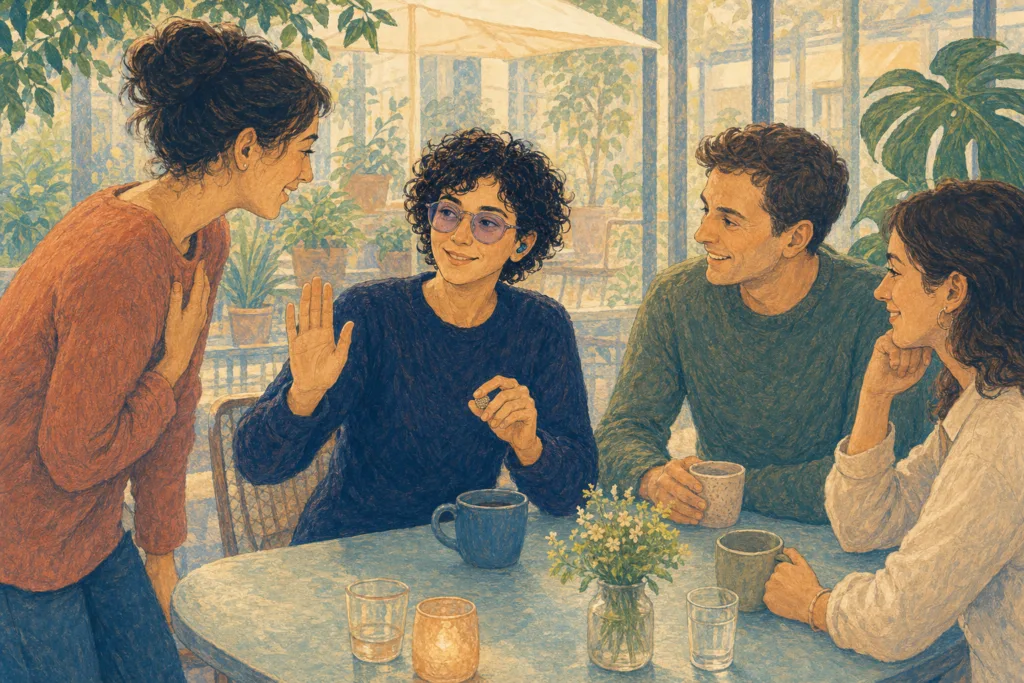
This may be the most difficult part for autistic people: talking about their needs or asking for help. I do not know how other people manage it, but I cannot wear my active noise-canceling headphones around others. Quite simply, I would no longer hear the noise—but I would no longer hear the other person either. And although I have stopped masking as much as possible, I am still afraid of how other people will look at me when I am wearing headphones.
There are alternatives, such as earplugs or devices specifically designed to reduce noise while keeping conversations audible. Loop Earplugs are one example.
Over time, I have learned to decline cheek kisses and, above all, hugs from people I do not feel sufficiently comfortable with—or whenever my sensory sensitivities simply make physical contact impossible.
The problem is not that autistic people adapt. Everyone does. The problem begins when this adaptation becomes permanent, unconscious, and so demanding that the person’s own needs eventually disappear altogether.
Masking is no longer a social strategy at that point. It becomes a survival strategy. And when you survive behind a mask for too long, you may eventually forget the face underneath it.
I will explore the story of my own social mask—from its development to its collapse—in greater detail in a dedicated article.
